
A Guide to Life-First Financial Planning
I’ve built wealth, now what?
Many executives and high earners have spent decades doing everything “right.” They’ve built impressive careers, accumulated investments, and saved diligently. By every conventional measure, they’re successful.
Yet a growing number are asking us questions that go beyond numbers. Our answer is a life-first financial plan, an approach we call Making Life Count®.
What Is Life-First Financial Planning? (Definition)
Life-first financial planning is a planning approach that starts by defining what a successful life looks like before building the financial strategy to support it. It reverses the traditional order of financial planning: instead of starting with numbers and working backward into a life, it starts with a life and builds the financial strategy to fund it.
Money is a tool, not the goal. The purpose of financial planning is to create more choices, more confidence, and more freedom to spend time and resources on what matters most to you, personally.
What Is the Difference Between Traditional Financial Planning and Life-First Financial Planning?
Traditional Planning Asks |
Life-First Planning Asks |
| How much should I save? | What kind of life do I want over the next 10, 20, or 30 years? |
| What’s the best investment? | What experiences matter most to me and my family? |
| When can I retire? | How does my career support the life I want? |
| How do I maximize returns? | What tradeoffs are worth making, and which aren’t? |
| What’s my number? | How do I want my wealth to shape my family, community, and future? |
Once life questions are answered, every financial decision has context:
- Investments become tools in service of a goal, not the goal itself.
- Taxes become planning opportunities, not year-end scrambles.
- Cash flow becomes intentional rather than reactive.
- Retirement becomes one meaningful chapter of life, not the finish line.
Why Does Life-First Planning Matter for High Earners?
Executives today face more career uncertainty than at almost any point in recent memory — AI-driven disruption, layoffs despite strong performance, volatile equity compensation, shifting tax policy, and broader economic uncertainty.
At Aspyre Wealth Partners, we’ve observed a critical insight many financially successful professionals miss: their greatest financial asset isn’t their investment account, it’s their career.
That’s why we encourage clients to manage their careers with the same discipline they apply to their investment portfolios. Career decisions directly influence:
- Future earning potential
- Tax planning opportunities
- Retirement timing
- Family flexibility
- Lifestyle choices
- Business ownership opportunities
- Long-term wealth creation
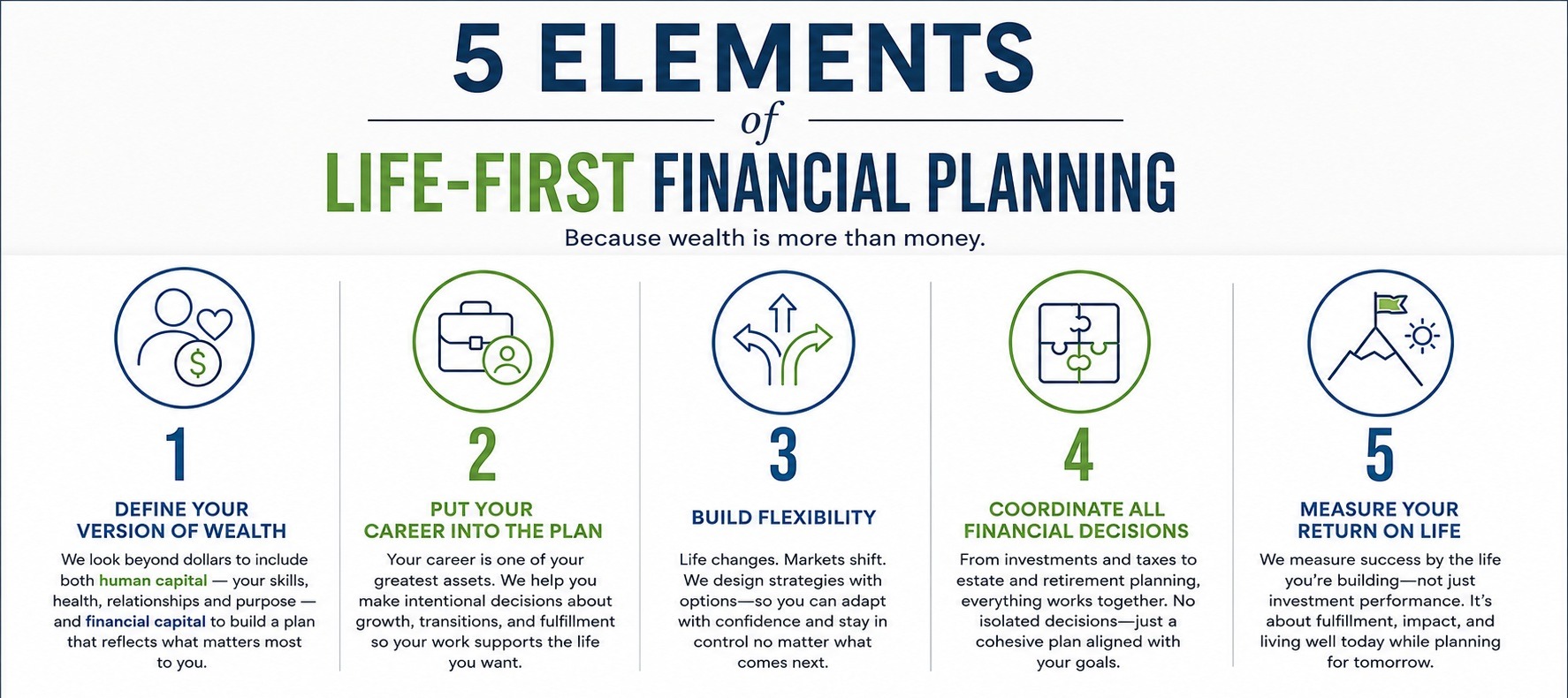
What Are The Elements of a Life-First Financial Plan?
1. Define Your Version of Wealth. Real wealth includes far more than an investment balance. It also includes human capital such as:
- Time
- Health
- Relationships
- Career satisfaction
- Purpose
- Flexibility
- Peace of mind
Financial capital plus human capital equals total wealth. The healthiest financial plans protect both simultaneously.
2. Put Your Career Into the Plan
Most financial plans treat employment as simply a source of income. We treat it as a strategic asset requiring its own planning. Questions we help clients answer include:
- Is your compensation structured efficiently?
- Are your equity awards creating unnecessary tax exposure?
- Could a career change increase your long-term wealth?
- Does your current role actually support the life you want?
3. Build Flexibility Instead of Chasing Certainty
In our experience, flexibility often becomes one of the most valuable assets a client owns. Markets change. Tax laws change. Employers change. Families change. Rather than trying to predict every outcome, we build plans that prepare for multiple possibilities, including:
- Tax diversification
- Multiple income sources
- Strategic cash reserves
- Flexible retirement timelines
- Estate planning updates
- Scenario planning for major career transitions
4. Coordinate Every Financial Decision
Life-first planning connects every part of a client’s financial life. Instead of isolated decisions, we coordinate investments, taxes, insurance, estate planning, executive compensation, charitable giving, and retirement strategy so they work together — because one decision often affects five others. Comprehensive, coordinated planning reveals the bigger picture that piecemeal planning misses.
Investment returns matter, but they’re only one measure of success. We want to know: Is your money helping you live the life you actually want?
A promotion that doubles your income but costs your health may not improve your overall wealth. An early retirement may not be fulfilling without a clear plan for what comes next. Financial success should create options, not obligations.
What Common Mistakes Do High Earners Make When Financial Planning?
Many successful professionals unintentionally design their lives around their finances instead of designing their finances around their lives. This leads to common planning mistakes:
- Postponing life until retirement
- Focusing only on investment performance
- Ignoring tax planning until year-end
- Overlooking the value of career planning
- Allowing equity compensation to become overly concentrated
- Making major financial decisions without an integrated plan
- Defining success only by income or net worth
Many successful professionals unintentionally design their lives around their finances instead of designing their finances around their lives.
Frequently Asked Questions
What does “life-first financial planning” mean? Life-first financial planning is a strategy that begins by defining the life a person wants to live, then builds the financial, tax, career, and investment strategy needed to support that life — rather than starting with a portfolio and working backward.
Who benefits most from a life-first financial plan? Executives, high earners, and business owners with complex compensation, significant career decisions ahead, and enough financial success to ask “now what?” tend to benefit most from this approach.
How is this different from traditional financial planning? Traditional planning typically starts with savings rates, investment selection, and a retirement date. Life-first planning starts with defining a meaningful life, then treats investments, taxes, and career decisions as tools to fund that life.
Why does career planning matter in a financial plan? For most high earners, career earnings — not investment returns — are the largest driver of lifetime wealth. Treating career decisions with the same strategic discipline as investment decisions can meaningfully affect taxes, retirement timing, and long-term wealth.
What Is Aspyre Wealth Partners’ Philosophy?
At Aspyre Wealth Partners, our goal isn’t simply to help clients retire wealthy. It’s to help them live well now, while preparing for a secure future.
This is Making Life Count®, the Aspyre Wealth Partners approach to life-first financial planning.